What Are Diamond Blades Made Of?
What are diamond blades made of? Learn the materials, bonding process, and design that allow these cutting tools to slice through concrete, stone, and tile.
If you’ve ever watched a contractor cut through concrete or stone, you might assume the blade itself is solid diamond.
That would make sense… but it’s not how these tools work.
But, what are diamond blades made of?
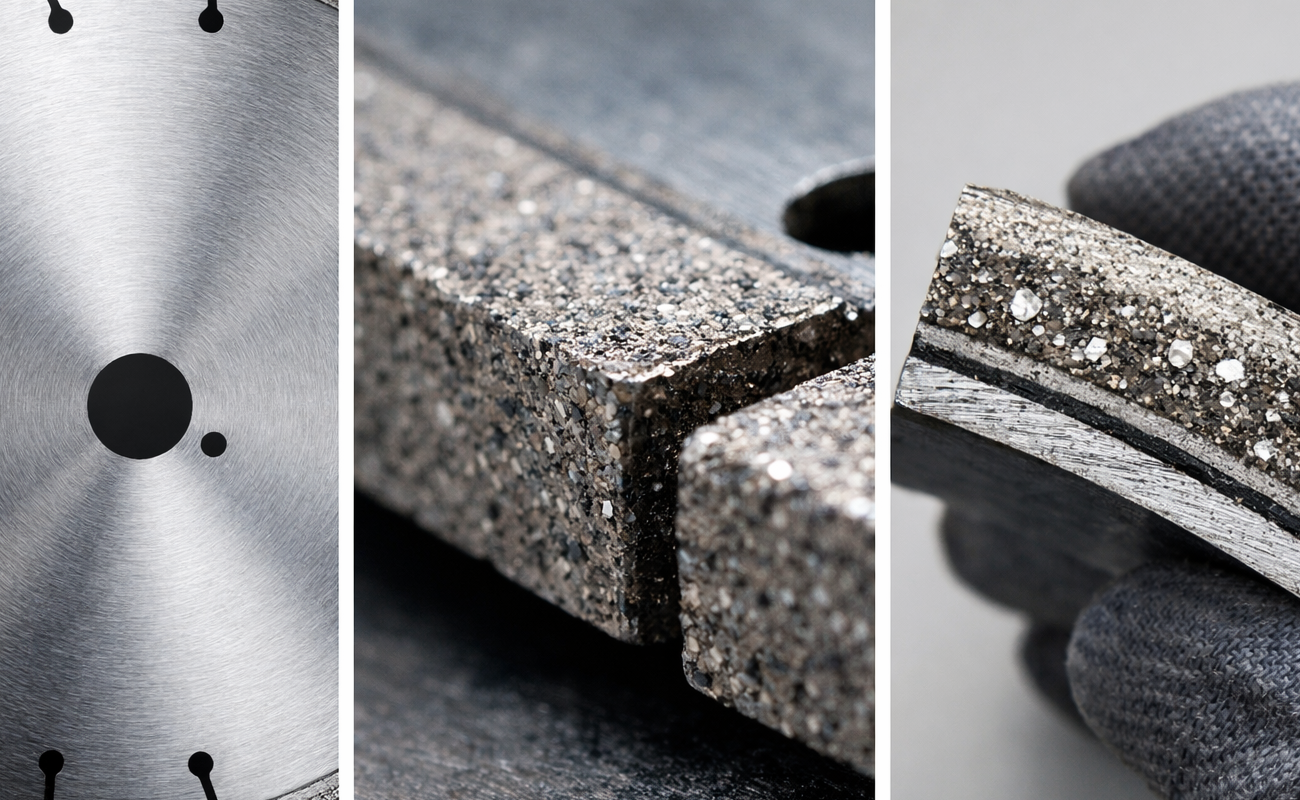
They are actually made from a mix of industrial diamonds, metal powders, and a strong steel core.
These materials work together so the blade can cut through extremely hard surfaces, such as concrete, asphalt, granite, and tile.
If you’re researching diamond saw blades for a project or for your business, understanding what goes into them helps you choose the right blade and use it correctly.
The truth is simple: the strength of a diamond blade does not come from diamonds alone. It comes from how the diamonds are held, supported, and exposed during cutting.
Let’s take a closer look at the materials that make these blades work.
The Three Main Parts of a Diamond Blade
Most diamond blades are built with three main components.
Each part has a specific job.
- Steel core
- Diamond segments
- Metal bond
Together, they create a blade that can grind through extremely hard materials without breaking.
1. Steel Core (The Blade’s Backbone)
At the center of every diamond blade is a steel core.
This is the round metal disc that holds everything together.
The core is usually made from high-strength heat-treated steel. It needs to be strong because it spins at very high speeds on saws and grinders.
The steel core provides:
- Structural support
- Blade stability
- Safe rotation at high RPM
Some cores also include slots or vents. These help reduce heat and vibration while cutting.
You may notice shapes like:
- Keyhole slots
- U-shaped slots
- Laser-cut expansion slots
These allow the blade to expand slightly when it heats up, preventing warping.
According to guidance from the U.S. Occupational Safety and Health Administration (OSHA), cutting tools operating at high speeds must maintain structural integrity and heat resistance to prevent blade failure.
2. Diamond Segments (Where the Cutting Happens)
The part that actually cuts material is called the diamond segment.
These are the small blocks attached around the edge of the blade.
Contrary to what many people think, the diamonds used in diamond blades are not jewelry-grade diamonds. Instead, they are industrial synthetic diamonds.
Synthetic diamonds are created in labs using extreme heat and pressure.
According to the Gemological Institute of America, lab-created diamonds have the same crystal structure as natural diamonds and are widely used in industrial cutting tools.
Industrial diamonds are perfect for cutting because they are:
- Extremely hard
- Durable under pressure
- Resistant to heat
- More affordable than natural diamonds
Each segment contains hundreds or thousands of tiny diamond crystals mixed with metal powders.
As the blade spins, these diamonds grind against the material being cut.
3. Metal Bond (The Diamond Holder)
The diamonds inside the segments need something to hold them in place.
That job belongs to the metal bond.
The metal bond is a mix of metal powders that surround and secure the diamonds during manufacturing.
Common metals used include:
- Cobalt
- Iron
- Bronze
- Tungsten
- Nickel
The metal bond determines how fast diamonds are exposed as the blade wears.
This process is known as controlled wear.
Here’s how it works:
- Diamonds grind against the material being cut.
- Over time, the metal bond slowly wears away.
- As it wears, new diamonds become exposed.
- The blade continues cutting effectively.
This constant exposure to fresh diamonds keeps the blade sharp.
Why Synthetic Diamonds Are Used

Natural diamonds may sound stronger, but they are not practical for cutting tools.
Synthetic diamonds are used because they offer better control during manufacturing.
Manufacturers can control:
- Diamond size
- Diamond strength
- Diamond shape
- Diamond concentration
This allows the blade to perform consistently.
According to research published by the International Journal of Refractory Metals and Hard Materials, synthetic diamond particles provide predictable cutting performance in industrial tools.
How Diamond Segments Are Attached to the Blade
The diamond segments must be attached securely to the steel core.
Two main methods are used.
1. Laser Welding
Laser welding is the most common method for professional blades.
A high-powered laser fuses the segment directly to the steel core.
Benefits include:
- Extremely strong bond
- Higher heat resistance
- Safer operation
- Longer blade life
Laser-welded blades are commonly used for:
- Concrete cutting
- Asphalt cutting
- Road work
- Construction projects
2. Sintering
Sintering is another manufacturing method.
This process uses heat and pressure to fuse the metal bond and diamonds together.
In some blades, the sintered segments are then attached to the steel core through brazing or welding.
Sintered blades are often used for:
- Tile cutting
- Masonry work
- General construction
Types of Diamond Blade Edges
The edge design also plays a role in how the blade cuts.
Different shapes are made for different materials.
1. Segmented Blades
Segmented blades have visible gaps between segments.
These gaps help:
- Improve airflow
- Reduce heat
- Remove debris
They are commonly used for cutting:
- Concrete
- Brick
- Asphalt
- Stone
Segmented blades are fast but produce rougher cuts.
2. Continuous Rim Blades
Continuous rim blades have a smooth cutting edge.
There are no gaps between segments.
This design allows for clean and precise cuts.
They are commonly used for:
- Tile
- Marble
- Granite
- Porcelain
The trade-off is slower cutting speed.
3. Turbo Blades
Turbo blades combine features of both designs.
They have small serrated edges that increase cutting speed while still producing fairly clean cuts.
These blades work well for:
- Granite
- Concrete
- Brick
- Stone
Why Bond Hardness Matters
The hardness of the metal bond must match the material being cut.
This is something many people overlook.
Here’s why it matters.
1. Soft Bond Blades
Soft bond blades wear faster.
That might sound bad, but it’s actually necessary when cutting very hard materials.
Examples include:
- Granite
- Porcelain tile
- Hard stone
The faster wear exposes new diamonds quickly.
2. Hard Bond Blades
Hard bond blades wear more slowly.
They are used for softer materials like:
- Asphalt
- Green concrete
- Sandstone
If the bond were soft, the blade would wear out too quickly.
Choosing the correct bond ensures the blade lasts longer.
Why Diamond Blades Don’t Stay Sharp Forever

Many people expect diamond blades to stay sharp forever.
But that’s not how they work.
Diamond blades cut through abrasion, not slicing like a knife.
Over time:
- Diamonds become dull
- Metal bond wears away
- Segments slowly shrink
Eventually, the blade needs replacement.
However, the controlled wear process ensures the blade continues to expose fresh diamonds, maintaining cutting performance for a long time.
Materials Diamond Blades Are Designed to Cut
Because of their construction, diamond blades can cut through extremely hard materials.
Common applications include:
- Concrete
- Reinforced concrete
- Asphalt
- Brick
- Granite
- Marble
- Porcelain tile
- Masonry
- Stone blocks
According to Construction & Demolition Recycling Magazine, diamond cutting tools are widely used across the construction and demolition industries because they offer greater precision and durability than traditional blades.
How Manufacturing Quality Affects Blade Performance
Two blades may look identical but perform very differently.
The reason usually comes down to manufacturing quality.
Important factors include:
- Diamond concentration in the segments
- Diamond quality and size
- Metal bond formula
- Segment welding strength
- Steel core balance
Higher-quality blades use carefully engineered diamond distribution, which improves cutting speed and durability.
Professional contractors often rely on premium blades because cheaper blades wear out faster and may overheat.
Conclusion
Diamond blades are not made from solid diamonds. Instead, they are built from a combination of engineered materials designed to work together under extreme cutting conditions.
A typical diamond blade includes:
- A strong steel core that provides structure and stability
- Diamond segments filled with synthetic industrial diamonds
- A metal bond matrix that slowly releases new diamonds during cutting
This design allows the blade to cut through hard materials like concrete, stone, and tile while maintaining performance over time.
Understanding what diamond blades are made of helps you choose the right blade, extend its lifespan, and achieve better cutting results.
When you know how these tools work, it becomes much easier to match the blade to the job and get consistent, reliable performance.